
Fresh milled English Muffins deliver tender crumb, classic nooks and crannies, and a subtle, nutty sweetness from fresh ground flour. This homemade English muffin recipe uses a preferment for tangy flavor and cooks them traditionally on a griddle, no oven required. Perfect for breakfast sandwiches or toasting with butter.
Course: Breakfast / Bread
Cuisine: American
Difficulty: Intermediate
Total Time: 3½–6 hours (Active: 1½ hours)
Yield: 12 muffins (102g each)
Calories per muffin: 209
What sets this recipe apart is the technique of using a paddle attachment to develop the gluten quickly without overworking the dough. It also uses hard white wheat milled fresh just before mixing. This variety is lightly colored and milder in flavor than red wheats, making it perfect for English muffins where a tender crumb and subtle sweetness are key.
Mill the Grain
Begin by milling 620 grams of hard white wheat on the finest setting your mill allows. This is the total amount for the full recipe so make sure you weigh out what the preferment calls for!
Prepare the Preferment
In a large mixing bowl, combine 380 grams of the freshly milled flour, 6 grams of instant yeast, 304 grams of lukewarm milk, and 216 grams of lukewarm water. Use a whisk or dough whisk to create a smooth, thick batter. The consistency should be similar to pancake batter.
Cover the bowl with plastic wrap or a damp towel and let it rest at room temperature for 1 to 4 hours. During this time, the yeast will begin fermenting the natural sugars in the flour. The mixture transforms from a smooth batter into a lively sponge that’s doubled in volume with a surface covered in small, delicate bubbles.
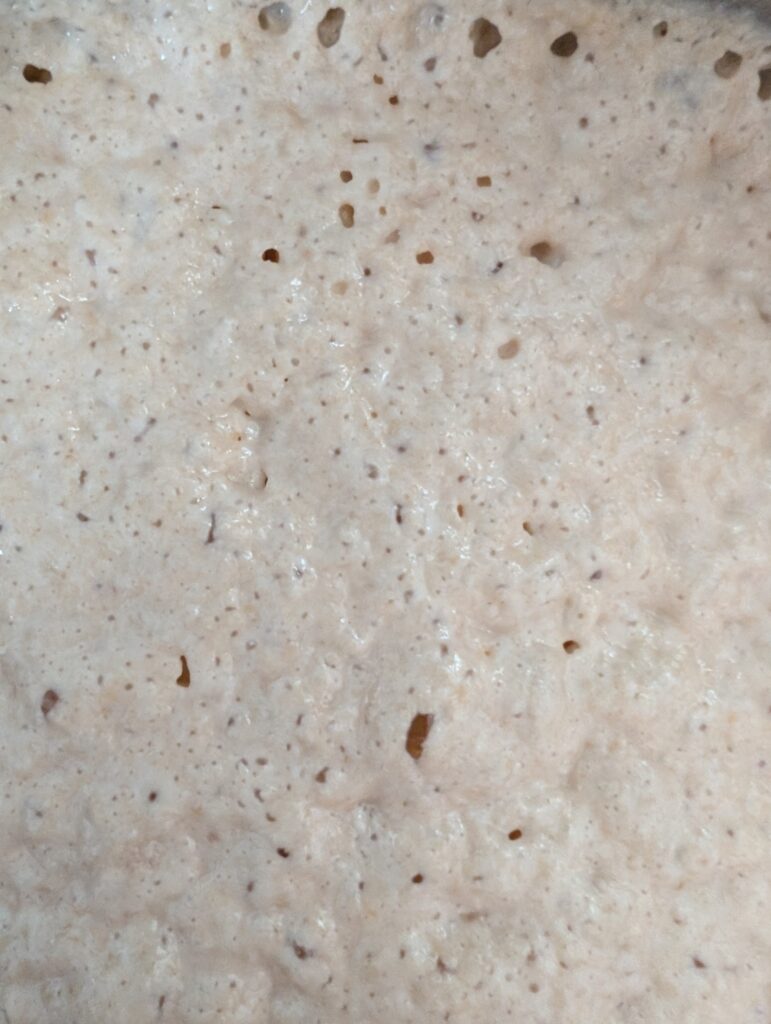
You can use it after an hour if you’re in a hurry, but letting it go for three to four hours deepens the flavor beautifully. By then, it should have doubled in size, with a slightly bubbly surface and a gentle tangy smell
A preferment is similar in idea to a sourdough starter but these are not considered sourdough. I will have a sourdough version up soon though!
Mixing the English Muffin Dough
Now, scrape that bubbly preferment into the bowl of your stand mixer and add:
- 240g more freshly milled flour
- 12g table salt
- 8g sugar (or 10g honey, if you prefer a touch of warmth)
- 36g melted unsalted butter
Give it all a brief stir to hydrate the flour, then cover and let it rest 15 minutes. This short “autolyse” helps the flour absorb moisture and begin gluten development before you mix it.
After resting, beat the dough using your paddle attachment for about 2-3 minutes. We are looking to form gluten development. The dough will be sticky and cling to the beater and bowl. By beating it quickly we will form enough gluten to help the dough hold it’s shape but not enough that we disrupt the nooks and cranies from forming.
First Rise
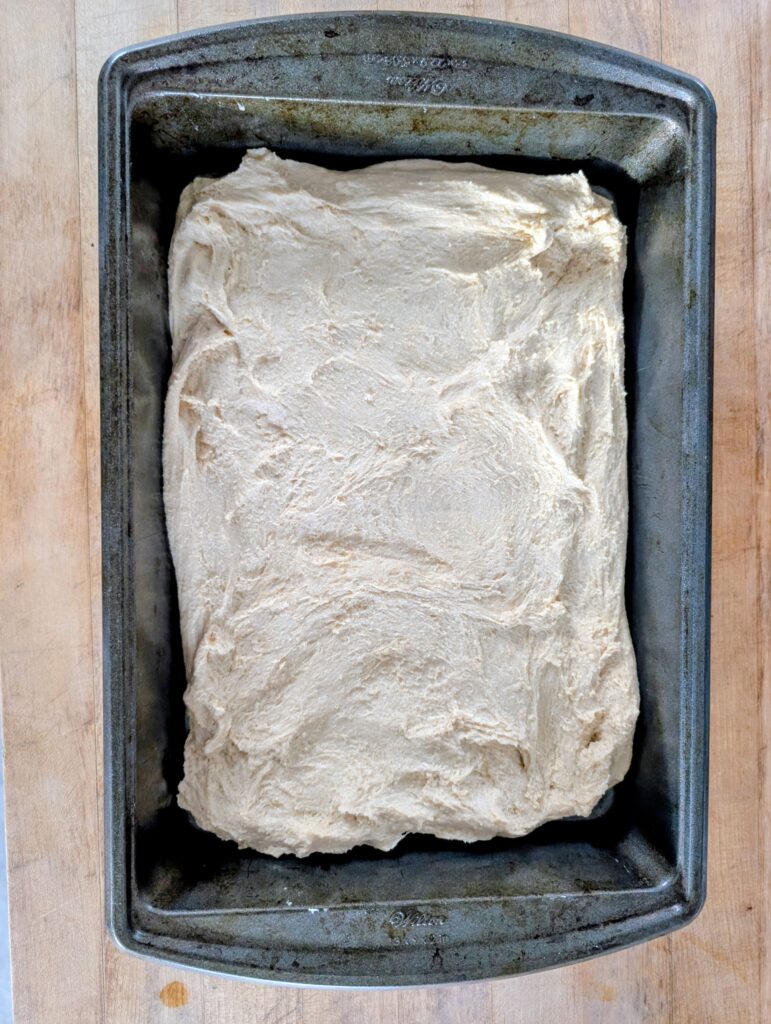
Grease a 13×9 pan, then stretch and pat the dough to fill the bottom as evenly as you can, especially into the corners. Cover it with a damp cloth or plastic wrap and let it rise until puffy and jiggly, risen about double. It’ll take around an hour, depending on your kitchen temperature.
The reason I use a rectangular pan is simply so that i don’t have to roll out and cut the muffins. I find this dough is very high hydration, which creates lots of nooks and crannies but it can be difficult to work with. By using the pan to pre-shape the dough, we can cut it into even pieces with minimal effort.
Shape the English Muffins
Here’s the fun part. Lightly mist your countertop with water and gently flip the dough out. You don’t want to deflate all that air you’ve built up. Cut the dough into 12 pieces. Four cuts along the long edge, three along the short.
Take each piece and gently shape it into a round. I do this by cupping my hand over the dough and making small circular motions, letting the surface tension pull it into shape. This dough is very sticky so utilize water on your hand, bench scraper and countertop. I keep a misting spray bottle next to me and reapply after every two or three balls.
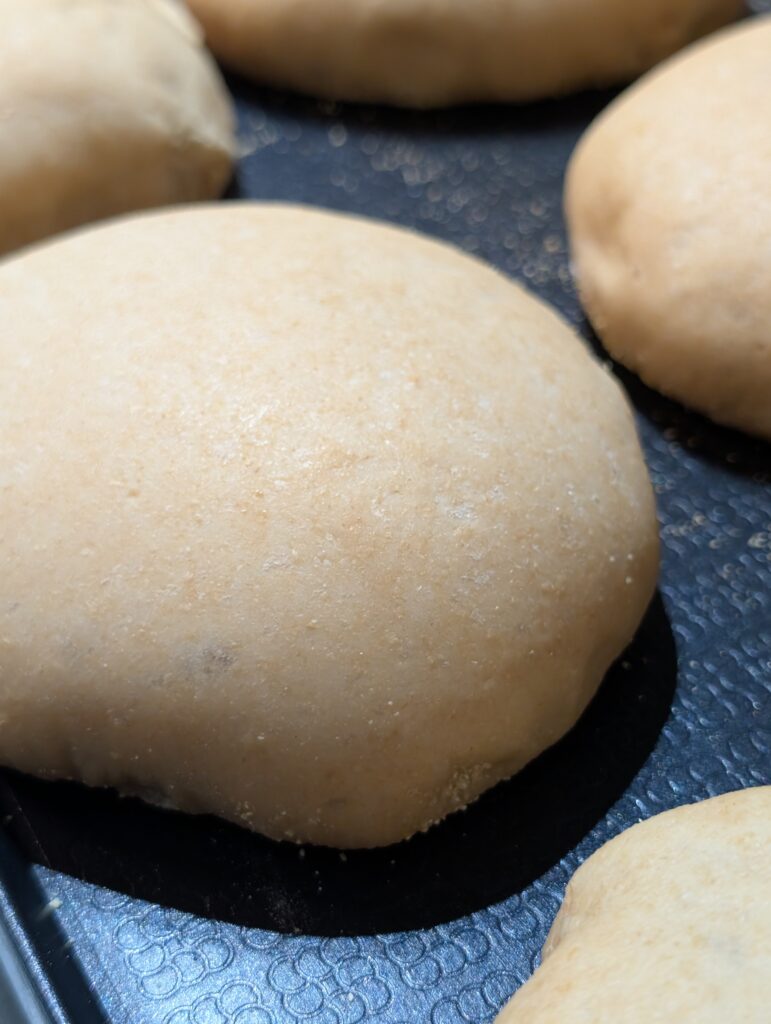
Using a dampened bench scraper, scoop under each shaped ball and lay it onto a cornmeal lined pan. Using water on your hand, pat them down into half inch disks. Sprinkle the tops with a little more cornmeal to keep them from sticking.
Cover again, and let them rest for 45 minutes to an hour, until they’re puffed and delicate to the touch. They should jiggle slightly when you shake the pan. If you find the finished english muffin does not have enough nooks and crannies, they probably needed to proof longer here.
Cooking
My favorite part of this recipe is how wonderfully old‑fashioned this step feels; no baking, no oven. Just a griddle or heavy skillet and a slow, gentle cook.
Make sure to be extremely gentle with the dough as the bubbles we created in the last proof are going to form all those amazing nooks and crannies! I use a bench scraper to transfer the dough to the griddle. Quickly scoop under the muffin then gently lay it onto the cooking surface.
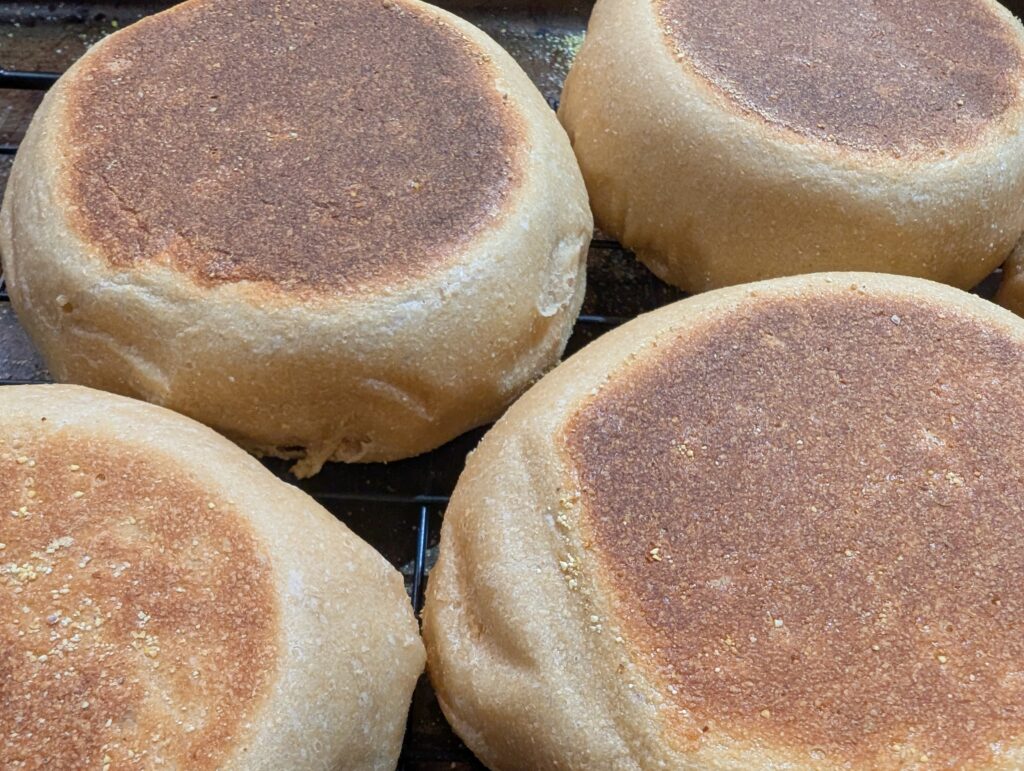
Preheat your griddle to 350°F (or medium‑low on the stovetop). Lay the muffins down carefully. They should sizzle softly but not brown too fast. Cook for 5-10 minutes per side, flipping once, until both sides are golden and the internal temperature reads 190–200°F.
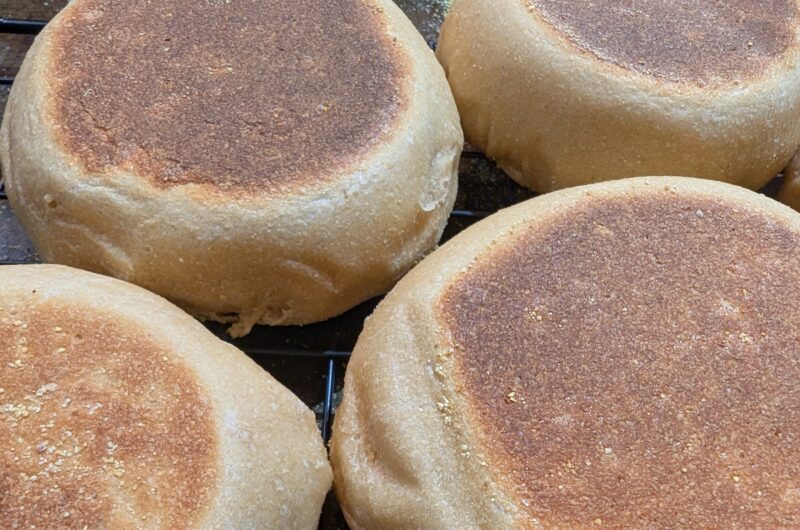
Transfer them to a wire rack to cool. They’ll soften as they rest, and the aroma is pure heaven.
To Serve
Once cool (if you can wait that long), split one open with a fork and toast it lightly. Butter melts instantly into the little tunnels, and if you go the honey route in the dough, you’ll notice that subtle sweetness coming through with each bite. They freeze beautifully, too. Cool completely before stashing them away in a bag.
Bread baking can sometimes sound intimidating, but these English muffins are forgiving and satisfying. There’s something so simple and rewarding about taking grain, turning it into flour, and then watching it puff up into these tender golden rounds, especially when your kitchen smells like a cozy bakery.
English Muffins
Course: BreakfastCuisine: AmericanDifficulty: Intermediate12
Muffins30
minutes30
minutes5
hoursFresh milled English Muffins deliver tender crumb, classic nooks and crannies, and a subtle, nutty sweetness from fresh ground flour. This homemade English muffin recipe uses a preferment for tangy flavor and cooks them traditionally on a griddle, no oven required. Perfect for breakfast sandwiches or toasting with butter.
Ingredients
- Preferment
380g Hard White wheat
6g instant yeast
304g milk, lukewarm
216g water, lukewarm
- Dough
240g Hard White wheat
12g table salt
8g granulated sugar or 10g honey
36g unsalted butter, melted (2 tbsp + 2 tsp)
40-60g yellow cornmeal, for dusting
Directions
- Mill your grain
- Mill 620g of Hard White Wheat on the finest setting. This is the combined weight from the preferment and the dough.
- Preferment
- In a large bowl, whisk together the 380 grams flour, yeast, milk, and water until smooth. The mixture will have the consistency of thick pancake batter.
- Cover the preferment and let rest at room temperature for 1 to 4 hours. After 1 hour the mixture will have grown a bit in volume and small bubbles will have appeared on top. After 4 hours, the preferment will have doubled in volume, have many small bubbles on the surface, and have a slightly sour aroma. The longer the mixture ferments, the more flavor the English muffins will have.
- Dough
- In the bowl of a stand mixer, add the remaining flour, salt, sugar, butter and the preferment.
- Cover and rest for 15 minutes.
- Beat dough with a paddle attachment for 2-3 minutes to create gluten structure.
- Place into a 13×9 rectangular pan and press to fill the bottom as best you can, focusing on the corners. Cover and let rise until puffy and jiggles when you shake the pan. This will take roughly 1 to 1.5 hours depending on the temperature.
- Shape the Muffins
- Gently flip the dough out onto a counter misted with water (very lightly).
- Using a bench scraper misted with water, cut the dough into 12 pieces by making 4 cuts along the long edge and three along the short edge.
- Taking one piece at a time, gently cup the dough with a damp hand and using the surface tension against the table, move the dough and your hand in circular motions until it forms a round. Use water to prevent sticking and work very gently. Less is more here.
- Place each round on a surface floured with cornmeal or semolina and gently press down to about 1/2 inch disk.
- Repeat with all the pieces, cover and rest for 45 minutes to an hour or until puffy and jiggly.
- Cooking
- Preheat an electric griddle to 350 degrees or heat a heavy bottomed skillet on the stove top.
- Gently place the English Muffins onto the hot griddle and cook slowly for roughly 7 to 10 minutes, flip gently and cook for 7 to 10 more. The internal temperature should read 190-200 degrees.
- Remove to a wire rack and cool.
Notes
- This is a very high hydration dough. Do not be tempted to add more flour. The higher hydration will help achieve the nooks and crannies in the finished english muffin.
Nutrition Facts
12 servings per container
Serving Size1 Muffin
- Amount Per ServingCalories209
- % Daily Value *
- Total Fat
3.3g
5%
- Saturated Fat 1.8g 9%
- Cholesterol 7mg 3%
- Sodium 295mg 13%
- Total Carbohydrate
39g
15%
- Dietary Fiber 6.8g 25%
- Total Sugars 2.5g
- Protein 7.5g 15%
* The % Daily Value tells you how much a nutrient in a serving of food contributes to a daily diet. 2,000 calories a day is used for general nutrition advice.